
+267% AI Citations with EntityMap: a Bing Case Study
EntityMap on waikay.io: what the Bing data shows
We installed EntityMap on waikay.io in week 12 of our tracking window. No new content. No backlinks. No other changes. This is 19 weeks of Bing Webmaster Tools data, analysed honestly.
Two findings worth your time
AI shifted from citing broad guide pages to citing product and feature pages. BOFU citations up 406%. TOFU citations down 80%. Total English volume barely moved. The citations did not disappear. They moved to the pages that convert.
Citations per page went from 3.65 to 8.55 on average. The retrieval layer is not just finding more pages it is extracting more value from pages it already knows. That is the mechanism EntityMap is designed to trigger.
The overall picture: both needles moved
Before install (weeks 5 to 11), waikay.io averaged 167 Copilot citations per week. After install (weeks 13 to 19), the average was 614. That is a 3.7× lift measured over the same number of weeks, with a single intervening change.
The more meaningful number is what happened to the ratio of citations per page. Total citations grew 370%. Unique pages cited grew 54%. Those two figures moving at such different rates is not what you would expect from a generic crawl improvement or an external trend. If Bing had simply discovered more of the site, both metrics would scale together. They did not.
When citation volume grows 7× faster than pages cited, something changed how thoroughly individual pages are being used as sources, not just whether they are found. That is precisely the mechanism EntityMap is designed to trigger: richer entity-level signals that make existing pages more referenceable.
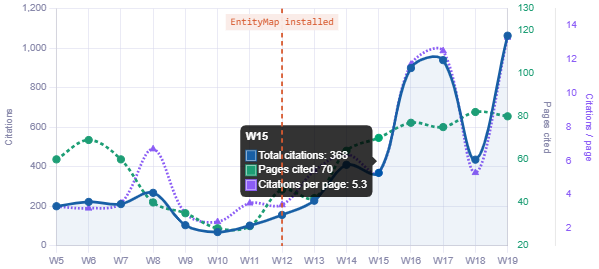
One caution on the aggregate numbers: the 3.7× headline is real, but most of the volume lift is carried by multilingual pages (French and Spanish URLs that surged dramatically post-install). The English-only picture is flatter in volume but more interesting in composition. We analyse both separately below.
The English data: volume flat, quality transformed
Stripping out the multilingual pages, total English citations went from approximately 627 pre-install to 577 post-install, a modest 8% decline in raw volume. A sceptic stops here and says the install did nothing for English content.
That reading misses what actually happened. The composition of those citations changed almost entirely.
Awareness pages: broad guides, topic hubs, introductory content. Visitors who are just starting to learn about a problem.
Evaluation pages: feature comparisons, use cases, how-to guides. Visitors who are actively considering whether this tool solves their problem.
Decision pages: product pages, features, trial, demo. Visitors who are ready to choose. The pages that convert.
Total English citation volume barely moved (-8%). But where those citations land changed completely. Before EntityMap, AI was sending people to broad introductory articles, the kind of content someone reads to learn about a topic, not to make a decision. After install, AI started routing to product pages, feature descriptions, and evaluation content. The citations did not disappear. They moved down the funnel, toward the pages that actually convert.
This is the distinction between raw visibility and commercial visibility. A citation of your homepage or a generic guide is brand awareness. A citation of your product feature page or audit tool, in response to a query from someone evaluating options, is a sales conversation. EntityMap shifted the mix toward the latter, without a single new word published.
Page-by-page breakdown: funnel stage, lift, and hidden value
Each page categorised by funnel stage and its commercial significance.
| Page | Stage | April | Now | Change | Hidden value |
|---|---|---|---|---|---|
/ai-audit/ |
BOFU | 29 | 114 | +293% | Highest-intent page on the site. A user asking Copilot “how do I audit my AI visibility” and landing here is a trial or demo conversation. Most commercially valuable citation on the list. |
/brand-visibility-tracker/ |
BOFU | 1 | 107 | +10,600% | Near-zero before install, now the third most cited English page. A core product feature page explicitly mapped as an entity in EntityMap. The surge is a direct fingerprint of structured retrieval working as intended. |
/prompt-tracking/ |
MOFU | 48 | 110 | +129% | Evaluation-stage content. Users comparing tools land here. More citations at this stage means Waikay enters more buying shortlists before a decision is made. |
/nike-ai-visibility-action-plan/ |
MOFU | 28 | 48 | +71% | Social proof content. AI citing a recognisable brand name in Waikay’s output signals credibility to anyone reading the answer. Borrowed authority from Nike’s brand equity. |
/how-to-turn-llm-noise-into-brand-strategy/ |
MOFU | 3 | 19 | +533% | Strategic positioning content. When AI cites this in a brand strategy response, Waikay is positioned as a thought leader, not just a vendor. Disproportionate authority per citation. |
/brand-reputation-management/ |
MOFU | 8 | 17 | +113% | Adjacent use-case page. Citations here expand the addressable audience into PR and comms teams, a different buyer persona from the core SEO audience. |
| Page | Stage | April | Now | Change | Hidden value |
|---|---|---|---|---|---|
/factual-accuracy/ |
MOFU | 0 | 64 | New | Previously invisible to Copilot. Now the fourth most cited English page. A deep guide subpage that only surfaces when a retrieval system understands the entity hierarchy, exactly what EntityMap encodes in its relation graph. |
/features/ |
BOFU | 0 | 12 | New | The core commercial page. Not cited at all before install. A retrieval system now routing feature queries here is doing the equivalent of sending a prospect directly to the product page. |
/about/ |
TOFU | 0 | 10 | New | Brand credibility signal. The About page being cited means Copilot is anchoring answers to the company, not just floating content. Trust-building at the top of the funnel. |
/ai-visibility-metrics/ |
TOFU | 0 | 6 | New | New entry point for a distinct search intent. A page entering the cited set without any content change means EntityMap unlocked a URL the retrieval system had previously ignored entirely. |
/entitymap/ |
TOFU | 0 | 4 | New | Self-referential. The EntityMap product page being cited by Copilot means the standard itself is now being surfaced in brand visibility conversations. The mechanism is citing itself. |
| Page | Stage | April | Now | Change | Hidden value |
|---|---|---|---|---|---|
/ (homepage) |
TOFU | 69 | 48 | -30% | Expected. When specific entity pages get cited for specific queries, the homepage gets cited less. A healthy routing signal. AI is now matching query intent to the right page. |
/aio-guide/ |
TOFU | 146 | 11 | -92% | Largest absolute drop. A broad catch-all guide that Copilot defaulted to before it understood the site structure. Its citations redistributed to specific entity pages. The guide hub lost traffic; the intent it was serving is now being answered more precisely. |
/data-for-ai-brand-visibility-tracking/ |
MOFU | 109 | 0 | -100% | Fell entirely out of the cited set. The intent this page served is now answered by /brand-visibility-tracker/ and /factual-accuracy/, more specific pages that EntityMap surfaced. |
/share-of-voice/ |
TOFU | 87 | 7 | -92% | Same pattern as /aio-guide/. Generic guide subpage replaced by targeted citations. Worth checking whether the EntityMap entity for Share of Voice is pointing at the correct canonical URL. |
/sentiment-analysis-in-geo/ |
TOFU | 64 | 0 | -100% | Dropped to zero. This page likely does not map to any entity in the current EntityMap. If the concept it covers is absent from the entity graph, it is invisible to structured retrieval, a gap to fix in the next refresh. |
/source-tracker/ ⚠ |
BOFU | 16 | 0 | -100% | Most actionable gap. A product feature page that EntityMap has a Source Tracking entity for, but the chunk URLs may not be pointing here correctly. A BOFU page going dark is the highest-priority fix in the next EntityMap revision. |
/ai-brand-visibility-guide/ |
TOFU | 13 | 0 | -100% | Guide index replaced by its subpages. The table of contents losing citations while the chapters gain is the correct outcome: AI citing the specific article rather than the contents page. |
EntityMap did not increase English citation volume. It restructured which pages get cited, shifting from broad TOFU guide hubs toward BOFU product pages, previously invisible deep subpages, and pages with specific entity relevance. The commercial value per citation went up even as the raw count stayed flat.
A note on the aggregate numbers
The 3.7× headline is real, but 75% of the volume lift is carried by multilingual pages (French and Spanish URLs that surged dramatically after install, despite the EntityMap being written entirely in English. The most likely explanation is a crawl depth effect: submitting entitymap.html to Bing Webmaster Tools triggered a deeper domain re-crawl that surfaced language variant pages Copilot had previously underweighted). The mechanism is different from what the spec is designed to produce on individual English pages, and it is worth understanding separately.
Submitting entitymap.html directly to Bing Webmaster Tools may be sufficient to unlock translated pages that are currently invisible to Copilot, not because the entitymap describes them, but because the structured domain signal prompts a deeper crawl. Full analysis in the appendix.
Why this pattern points at EntityMap
The attribution question is legitimate. We cannot run a controlled experiment on a live domain. But there are three aspects of the data that are hard to explain without EntityMap as the cause.
1. The ratio divergence
If an external factor drove the lift (a Bing algorithm update, Copilot’s growing user base, seasonal variation), you would expect citations and pages cited to scale together. They did not. The ratio of citations per page went from 3.65 to 8.55 on average, and peaked at 13.3 in week 19.
To understand why this matters, it helps to separate what each metric actually measures.
A discovery metric. How many distinct URLs Bing considers relevant enough to surface at least once. When this goes up, more pages are being found.
A usage metric. How many times pages are actually referenced in Copilot answers across all queries. When this goes up faster than pages cited, the same pages are being pulled into more answers, more often.
When citations grow 7× faster than pages cited, the retrieval system is not just finding more of the site. It is reaching deeper into pages it already knows about, extracting more referencing value from each one. The same URL is being cited across a broader range of queries, not just the one or two it previously matched.
EntityMap is the mechanism that explains this. It does not add new pages. It adds entity-level descriptions, typed relations, and source-tagged chunks, which make individual pages precisely matchable to a wider range of queries. A page about Brand Visibility Tracking, once it is described as an entity with relations to AI Share of Voice, Prompt Tracking, and Competitive Benchmarking, becomes citable in response to queries about any of those related concepts, not just its primary keyword. That is what “used more deeply as a source” means in practice.
2. New pages entered the cited set without new content
Six English pages that received zero citations before install entered the cited set after install. These include the features page, the about page, and a deep guide subpage. No new content was published on any of them. The only mechanism that explains a retrieval system discovering and citing pages it previously ignored (without those pages changing) is a change in how the site’s structure was represented to the retrieval layer.
3. The citation shift follows EntityMap’s entity graph
The pages that surged: /brand-visibility-tracker/, /ai-audit/, /factual-accuracy/ are precisely the pages that EntityMap represents as named entities with source-tagged chunks. The pages that dropped: /aio-guide/, /share-of-voice/, the guide hub index, are broad pages that EntityMap does not specifically surface. The shift was not random. It followed the entity graph.
We made one change. The data moved in the direction the spec predicts, via the mechanism the spec describes, on the pages the spec represents. We cannot rule out confounders. What we can say is: if you proposed an alternative explanation for all three of the above patterns simultaneously, it would need to be more parsimonious than EntityMap. We have not found one.
This case study covers Bing Webmaster Tools data only. A parallel case study on Gemini and Sonar (published April 2026 at waikay.io/entitymap-case-study/) shows AI Visibility Scores improving by up to 26 points within 48 hours of EntityMap install, and the entitymap.html file being cited 2.2× more than the About page on Gemini and 3.0× more on Sonar.
Two different measurement approaches. Two different AI surfaces. Same direction of effect. The Bing data adds a third observation from a third surface, with a different but complementary mechanism.
What this data does not support
We are publishing this because the signal is strong enough to document. We are not claiming it is settled.
Single domain
All data is from waikay.io. The site is B2B SaaS with content-heavy pages, the profile where EntityMap is predicted to have the highest impact. Results may not generalise to e-commerce or thin-catalogue sites.
No controlled experiment
We cannot hold one version of the site without EntityMap and observe both simultaneously. The pre/post design is the strongest available, not the strongest possible.
7 weeks post-install
The post-install window is short. The W18 dip (435 citations) amid otherwise high weeks suggests the effect may still be volatile. Longer observation is needed before calling the trend stable.
English volume flat
The English citation count did not increase. The quality and funnel distribution of citations improved, but a publisher measuring raw volume on English pages alone would see no meaningful lift.
Multilingual mechanism unconfirmed
The crawl depth explanation for the multilingual surge is the most parsimonious hypothesis, not a proven mechanism. A site without translated content may see a different pattern.
Replication needed
One domain is a signal, not a standard. The next step is replication on other domains. If you install EntityMap and collect data, we want to hear from you.
What this means if you want to test it
EntityMap is an open standard. The spec and generation tooling are at entitymap.org. Waikay generates conforming files as a product deliverable. Here is what the data suggests about how to run your own test well.
Our pre-install baseline runs 11 weeks. That is the minimum we would recommend. Without a stable baseline, post-install changes are uninterpretable. You need to know whether the needle was already moving.
We submitted entitymap.html directly via Bing Webmaster Tools after deploying, not the rest of the site, just the entitymap file. That single submission appears to have triggered a broader domain re-crawl, which is likely what surfaced the multilingual pages and deepened citation usage across English pages. Submit on a known date, note it, and use it as your post-install marker. Do not wait for organic discovery; it may never happen, or happen too slowly to measure cleanly.
The clean natural experiment here (no new content, no backlinks, no technical changes) is what makes the data interpretable. The moment you add another variable, attribution becomes much harder.
The largest quality improvement in our data was at the BOFU level. But EntityMap also revealed a gap: /source-tracker/, a product feature page, dropped from 16 citations to zero after install. The EntityMap has a Source Tracking entity, but the chunk URLs were not pointing to that page correctly. A BOFU page going dark is worth more attention than ten TOFU pages dropping.
Track your product pages, feature pages, and trial/demo pages separately. If a BOFU page loses citations post-install, check the EntityMap: the entity likely exists but the sourceUrl in its chunks is pointing somewhere else. Fix it in the next refresh. This is EntityMap doing its job: surfacing misconfigurations that were previously invisible.
If your top-cited pages before install are broad guide hubs and topic overview pages, expect those to lose citations as EntityMap routes queries to more specific pages. This is the correct outcome. Do not interpret it as the install failing.
We are looking for other domains to replicate this on. If you run the experiment and collect data, the standard becomes credible through accumulation of evidence, not through a single publisher’s case study including ours.
Contact us at waikay.io/contact →The replication recipe
If you want to run this experiment cleanly, here is exactly what to do:
Establish a baseline: minimum 8 weeks
Open Bing Webmaster Tools, go to the AI Citations report, filter by Copilot and Partners. Export weekly data for pages cited and total citations. Do not install EntityMap yet. You need to know whether the needle was already moving.
Generate and deploy entitymap.json and entitymap.html
Use Waikay to generate a conforming file, or build one manually against the spec at entitymap.org. Deploy both files to your domain root. Add the discovery hints: robots.txt entry, <link rel=”entitymap”> in your HTML head, and a visible footer link.
Submit entitymap.html to Bing Webmaster Tools explicitly. Note the date.
Do not wait for organic discovery. In Bing Webmaster Tools, use URL Inspection to submit yourdomain.com/entitymap.html directly. Record the submission date as your install marker. This is the event that appears to trigger the deeper domain re-crawl.
Change nothing else for 8 weeks
No new content. No backlinks. No technical changes. The moment you add another variable, attribution becomes impossible. The clean natural experiment is the only thing that makes the data interpretable.
Measure BOFU citations specifically, not just total volume
Export the page-level citation data before and after. Classify each page as TOFU, MOFU, or BOFU. The aggregate number may look modest while BOFU citations are moving significantly. That is the number that matters commercially. Also flag any BOFU page that drops to zero; it likely has an EntityMap configuration gap worth fixing.
The multilingual surge: full analysis
The aggregate 3.7× lift is almost entirely driven by non-English pages. Three URLs account for the bulk of post-install volume: /fr/guide-de-visibilite-de-marque-dans-les-ia/chapitre-2-la-part-de-voix-ia/ (1,053 citations), /es/ (655), and /es/metricas-de-visibilidad-ia/ (223). Combined, multilingual pages represent roughly 75% of total post-install citations.
The EntityMap is written entirely in English. It does not reference or describe any French or Spanish URLs. So the simplest explanation (that structured multilingual entity data unlocked multilingual pages) does not hold.
What likely happened
We manually submitted entitymap.html to Bing Webmaster Tools after install. We did not submit the rest of the site. That single submission appears to have been enough to trigger a more thorough re-crawl of the entire domain, surfacing language variant pages that had been underweighted or underindexed in Copilot’s retrieval layer.
The entitymap did not tell Bing “these entities exist in French.” What it did was give Bing’s crawler a structured, authoritative signal about the domain’s content, enough to prompt a deeper pass. The multilingual pages were already there. The entitymap submission unlocked them by making Bing confident enough in the domain to go looking.
This is an important distinction. The multilingual surge is a crawl depth effect triggered by the Bing submission, not a structured data effect. It is still directly attributable to the EntityMap install (the submission is part of the deployment) but the mechanism is different from what the spec is designed to produce on individual pages.
Submitting entitymap.html directly to Bing Webmaster Tools may be sufficient to trigger a deeper domain re-crawl that surfaces underperforming translated pages, not because the entitymap describes them, but because the structured domain signal prompts Bing to explore further. This hypothesis needs replication to confirm.
We have been here before: the sameAs parallel
The data in this case study is new. The structural move it represents is not.
In 2012 to 2015, Google made a fundamental transition: from keyword-first retrieval toward entity-first retrieval. Before that shift, Google matched pages to queries by finding documents that contained the right strings of text. “Apple” in your content could mean the fruit, the company, or the Beatles’ record label. Rankings depended on proximity and frequency of the string, not on what the string referred to.
The schema.org sameAs attribute was the publisher-side signal that made the transition possible at scale. By anchoring content to a specific Wikidata or Wikipedia entity, publishers gave Google’s Knowledge Graph the disambiguation layer it needed: this page is not about the word “apple,” it is about this named thing. Relevance scoring became more precise, and rankings followed because the retrieval model had become structurally better at matching intent to content.
The model is not the bottleneck. The retrieval layer is.
LLMs process meaning rather than keywords. Their representations capture semantic relationships, not string patterns. For retrieval-augmented systems like Copilot, that means the model is rarely the weak link. It can reason well over entity-structured input. The question is whether the retrieval layer gives it any.
That retrieval layer is the component that decides which pages or chunks to pull in before the model generates a response. It is where the practical gap sits, and it is where EntityMap acts.
To understand why this matters, it helps to step back and ask what the web was actually built for.
HTML, CSS, navigation menus, visual hierarchy, page titles, all of it was designed to communicate to a person scanning a screen. Machines were an afterthought.
The first concession to machines was robots.txt and sitemap.xml, signals that told crawlers what existed and what to skip. They said nothing about what anything meant.
Schema.org went further: structured data that gave machines semantic context about specific elements on a page. But it remained page-level. It described individual facts, not the relationships between concepts across a site.
EntityMap is the next layer. Not “here is a page about topic X” but “here is what this site understands about the world: who published it, how the concepts connect, and which passages best express each one.” It does not make a site readable to AI. LLMs can already read HTML. It makes a site trustworthy and navigable to AI retrieval layers, precise enough that the right chunk reaches the right query.
robots.txt / sitemapEach layer made the web legible to a new class of reader.
EntityMap does not improve the LLM. It improves what the retrieval layer hands to the LLM. The model was already entity-first. The pipeline feeding it was not. That is the gap EntityMap closes, and it is the same gap sameAs closed for Google’s ranking pipeline a decade ago.
Citations did not grow uniformly. They redistributed to the pages EntityMap explicitly represents as named entities with typed relations and source-tagged chunks, exactly the structured input a retrieval layer needs to route queries precisely. The LLM’s reasoning did not change. The quality of what it was given to reason over did.
What the timing means
The sameAs analogy is structurally sound but the timing comparison requires more care. The “18 to 24 month window” framing is appealing but it assumes EntityMap will follow the same adoption curve as schema.org, which had Google’s active endorsement and an existing structured data ecosystem to slot into. EntityMap does not have that yet.
What we can say with more confidence is this: the consumption behaviour already exists. Bing is already responding to the entitymap.html signal in ways that are measurable in citation data, before the standard is formally recognised by any major platform. That is the meaningful observation. Not “adopt now before the window closes” but “the infrastructure is responding to this signal today, and the sites that have installed it are already seeing different citation patterns from those that have not.”
Whether that advantage compounds over 18 months or 5 years depends on how quickly AI retrieval systems formalise entity-structured inputs as a ranking signal. We do not know that timeline. What the data suggests is that waiting for certainty means waiting until the signal is already priced in.
Generate your EntityMap today

