
Ask ChatGPT to recommend a solution in your category. If your brand doesn’t appear, the problem runs deeper than any single page or ranking. The AI never learned to associate your brand with the topics buyers are asking about.
AI Topical Presence is a metric that measures how strongly and how broadly a brand is associated with relevant commercial topics in AI-generated recommendations.
AI Share of Voice tells you if you appear in AI-generated answers. AI Topical Presence tells you what for – and that is the question that explains your score and tells you what to do about it.
The short version
Google ranks pages. AI models build associations. AI Topical Presence measures how strongly (and how broadly) an AI connects your brand to the commercial topics that matter in your market.
How AI answers questions about your market
When someone asks ChatGPT, Gemini, or Perplexity for a product recommendation, the model does not search the web the way Google does. Instead, draws on a vast network of associations built during training; billions of web pages, community discussions, review platforms, and technical documentation absorbed over a training window that may be one to three years old.
From all of that, the model built a mental model of your market: which brands exist, what they are good at, which use cases they cover, which standards and frameworks they are associated with.
When a buyer asks for a recommendation in an AI search interface, the model retrieves the brands whose topic associations best fit the query. It is not ranking pages. It is matching brands to concepts.
This is fundamentally different from how Google works. Google ranks pages. AI models build associations. A well-optimised page for “endpoint protection software” can rank number one in search while the AI model has only shallow associations connecting that brand to endpoint protection . This is because the page exists but the conceptual territory was never built across the broader web.
This is why brands with strong search rankings can still be nearly invisible in AI recommendations. The investment went into keyword-level optimisation. AI visibility requires something different: depth and breadth of association across many contexts.
What topic association means
Topic association is the set of concepts the AI connects to a brand when it generates a recommendation.
Take a brand in the cybersecurity software space. When an AI assistant answers “recommend enterprise security tools,” it does not just retrieve brand names. It matches brands against a cluster of associated concepts: endpoint protection and zero trust architecture, compliance frameworks like SOC 2 and ISO 27001, threat intelligence and identity access management, and standards like NIST or MITRE ATT&CK.
A brand strongly associated with all of those concepts appears consistently across AI recommendations. A brand associated with only one or two (or whose coverage is thin appears infrequently) or not at all.
This is the gap that AI Topical Presence surfaces. Not “you’re not mentioned,” but “the AI doesn’t connect you to these specific topics that buyers ask about.”
Topic association gaps come in two varieties:
– Missing associations – the AI has not learned to connect your brand to a relevant concept. Your content does not cover it, you do not appear in discussions about it, and the model has no basis for the connection. This is the more common problem, and the more fixable one.
– Displaced associations – a competitor has built such thorough coverage of a topic that the AI connects it primarily to them. This is harder to address, but rarer than it appears. AI models are not zero-sum in the way search rankings are. However, it is worth noting that while the association layer is not zero-sum, the output layer often is: most recommendation prompts return three to five brands.
In practice, most AI visibility gaps are missing association problems. The competitor is not winning because they locked up the territory, they are winning because your brand was absent from the conversation. Absence is more fixable than displacement. That is good news.
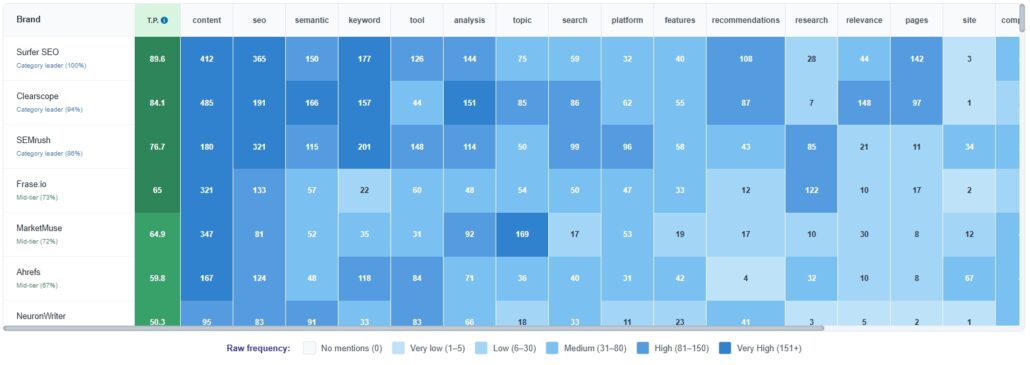
Example of Topic Association table with AI Topical Presence computed for each brand appearing in AI responses
Why measuring AI Topical Presence matters
AI Share of Voice is the metric most teams start with, and it is a reasonable place to start. It tells you how often your brand appears across a set of relevant AI-generated responses.
But share of voice, on its own, is a score without a diagnosis. Knowing your AI Share of Voice is 8% tells you where you stand. It does not tell you why you are at 8%, or which specific topics are keeping you out of AI recommendations where you should appear.
Two brands can have identical share of voice scores for entirely different reasons: one is broadly associated with many topics but weakly on each; another is deeply associated with two or three but invisible everywhere else.
AI Topical Presence is the metric that explains the score. It answers three questions that share of voice cannot:
– Where are you visible? Which topics does the AI already associate with your brand, and how strongly?
– Where are you missing? Which topics do competitors own that your brand has no association with at all?
– How fragile is your position? Is your AI visibility concentrated in one or two topics, or distributed across many? A concentrated brand is one model update away from a significant drop.
Example: A cybersecurity brand has an AI Share of Voice of 12%. This is reasonable for a competitive category. But its AI Topical Presence analysis shows strong associations with “firewall” and “antivirus,” and near-zero associations with “zero trust,” “SASE,” and “cloud security posture.” Those are exactly the topics buyers ask about when evaluating enterprise security platforms. The 12% SOV is fragile – concentrated in legacy concepts, absent from the queries that drive pipeline.
AI SOV tells you if you appear. AI Topical Presence tells you what for.
A brand with high AI SOV but weak AI Topical Presence is appearing often but shallowly , vulnerable to any shift in how the model weights associations. A brand with strong AI Topical Presence but lower SOV has built the right foundations but not yet achieved the reach. The combination tells the full story.
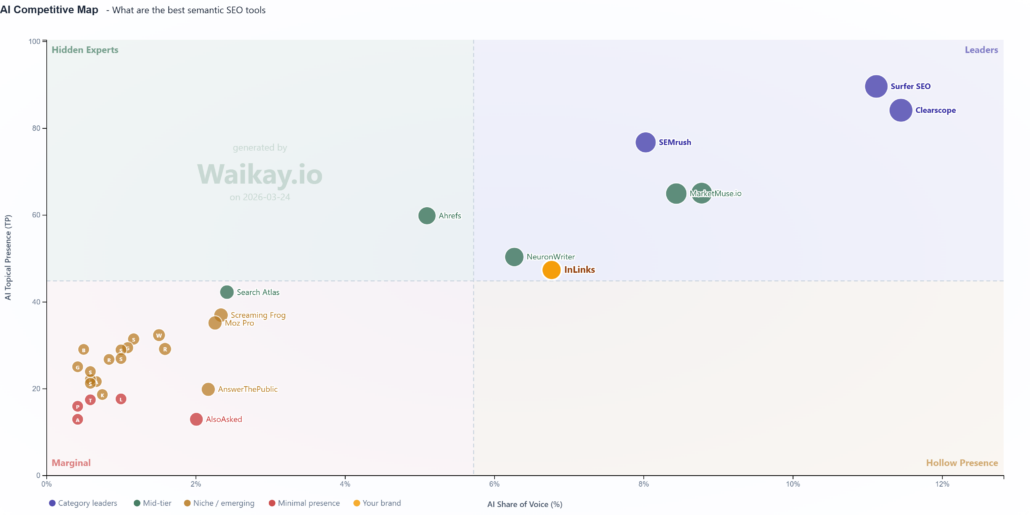
In the above screenshot, Clearscope has the highest AI share of voice for “What are the best semantic SEO tools”, but Surfer SEO has the highest Topical Presence, due to stronger related topic associations.
What AI Topical Presence measures
AI Topical Presence is a single score (0-100) that captures the strength and shape of a brand’s topic association profile across AI recommendation prompts. It is built from three components, combined with weighted coefficients that reflect their relative importance.
1. Depth
Depth measures how strongly the AI connects your brand to relevant topics, weighted by how important those topics are in your market.
For each topic, we measure how frequently the AI associates your brand with it relative to the most-mentioned brand for that topic. That per-topic ratio is then weighted by the topic’s importance in your market and summed across all topics. The result is normalised against the market leader’s depth score.
|
Depth = Σ (frequency / marketMaxFreq) × topicWeight
DepthNorm = Depth / maxDepth |
A brand that appears frequently in AI recommendations about high-value, high-intent topics scores higher on depth than a brand that appears in lots of peripheral conversations.
Analogy for CMOs: Think of depth as share of voice in the conversations that actually drive purchase decisions, not just brand awareness mentions.
2. Breadth
Breadth measures how many of the core commercial topics in your market the AI associates with your brand. It does so with a soft scoring curve rather than a hard threshold.
Rather than a binary “above threshold or not,” breadth uses a logarithmic function that gives partial credit for emerging associations. A brand that is beginning to appear in discussions of a topic gets some credit, while a brand with strong, established presence on that topic gets full credit. Each topic’s contribution is weighted by its importance, and the calculation covers the top 40 core topics in the market. The result is normalised against the market leader’s breadth score.
|
Breadth = Σ min(1, log(1 + frequency) / log(1 + presenceThreshold)) × topicWeight
BreadthNorm = Breadth / maxBreadth |
Why breadth matters: Buyers ask questions in many different ways. A brand with broad associations appears across more AI recommendation queries. A brand with narrow associations only surfaces when the query happens to match its small set of strong topics.
3. Concentration
Concentration measures how evenly topic associations are distributed, using a Herfindahl-Hirschman Index (HHI) of your brand’s mention share across topics.
| Concentration = Σ (frequency / brandTotal)² |
A brand where one topic accounts for 80% of all its AI mentions is essentially a one-topic brand in the AI’s model of the market. High concentration is a fragility risk: one model update or one competitor moving into that topic, and the score drops significantly. Concentration is penalised in the final formula (lower concentration contributes positively to the score).
The AI Topical Presence formula
The three components are combined using weighted coefficients:
| TP = ( α × DepthNorm + β × BreadthNorm − γ × Concentration ) × 100 |
The additive weighted structure – rather than a purely multiplicative formula – matters for a practical reason. In a multiplicative model, a zero on any single component would collapse the entire score, which would unfairly punish brands that are narrowly strong (deep on a few topics but not yet broad). The weighted approach allows each component to contribute proportionally while still reflecting the balance between depth, breadth, and fragility.
A brand scores well by being strongly associated with many relevant topics – and not depending on any single one of them.
Example: A brand with DepthNorm of 0.8, BreadthNorm of 0.7, and Concentration of 0.2, using illustrative weights of α=0.45, β=0.40, γ=0.15, scores: (0.45 × 0.8 + 0.40 × 0.7 − 0.15 × 0.2) × 100 = 61.0. A brand with the same depth and breadth but Concentration of 0.7 scores: (0.45 × 0.8 + 0.40 × 0.7 − 0.15 × 0.7) × 100 = 53.5. The fragility penalty reduces the score, though less drastically than in a multiplicative model – which is appropriate, because a concentrated brand is not worthless, just more vulnerable.
How to interpret an AI Topical Presence score
AI Topical Presence is a relative metric. It is normalised against the highest-scoring brand in the dataset, so a score of 100 always belongs to whoever has the strongest association profile in that competitive set. The score is market-relative, not absolute, which is the honest way to report it.
Because Depth and Breadth are normalised separately against their respective market leaders, the leading brand on each component may be a different company. A brand can score 1.0 on DepthNorm and 0.4 on BreadthNorm if it is the depth leader but mediocre on breadth. This means a mid-tier overall score could reflect very different underlying profiles. The component breakdown tells you which lever to pull.
In emerging or fragmented categories, the highest score in the dataset may be quite low in absolute terms – sometimes below 35. That does not mean the metric is broken. It means no brand has yet built dominant topic associations in that space. Which is, in itself, a strategic insight: the territory is still available.
|
Tier
|
% of leader
|
What it means
|
Strategic signal
|
|---|---|---|---|
|
Category leader |
≥ 75% of max |
Broad, consistent AI presence |
Own the territory |
|
Mid-tier |
45–74% |
Visible but patchy |
Identify and fill gaps |
|
Niche / emerging |
20–44% |
Narrow or emerging signal |
Build breadth urgently |
|
Minimal presence |
< 20% |
Largely absent from AI answers |
Start from scratch |
What an AI Topical Presence gap tells you (and what it does not)
When a gap surfaces – a topic that competitors are strongly associated with in AI recommendations, but your brand is not – the instinct is to commission a content brief. That instinct is often premature.
An association gap can mean one of three things:
A product gap – your product does not cover the capability at all. Writing content about it creates a different problem: you build AI visibility for something you cannot deliver.
A documentation gap – your product covers it, but it is not documented in a way the AI can find and associate with your brand.
A content depth gap – it is documented, but the coverage is too thin or too narrow for the AI to have built a meaningful association.
Each answer leads somewhere different. A product gap is a roadmap conversation. A documentation gap is a technical writing conversation. A content depth gap is a content strategy conversation.
The AI Topical Presence analysis forces the right question before the content investment begins. That is a different category of strategic value than a tool that just outputs a keyword list.
The question to ask is not “do we have a page about this topic?” It is: if someone read everything the AI knows about this topic, would our brand emerge as a credible, knowledgeable participant in the conversation?
The bottom line
AI Topical Presence is not a vanity metric. It is a diagnostic tool that tells you, with reasonable precision, where your brand sits in the AI’s model of your market and which specific topics represent gaps that are costing you pipeline.
For SEOs, it reframes the work: the goal is no longer just to rank pages, but to build conceptual territory that AI models learn to associate with your brand across AI search and recommendation surfaces.
For CMOs, it answers a question that analyst reports and battle cards cannot: what does the AI think your brand is relevant for? And what does it think about your competitors?
Those are increasingly the questions that determine whether you appear in the AI recommendation before the buyer reaches your sales team.
Written by Fred Laurent – March 2026

